


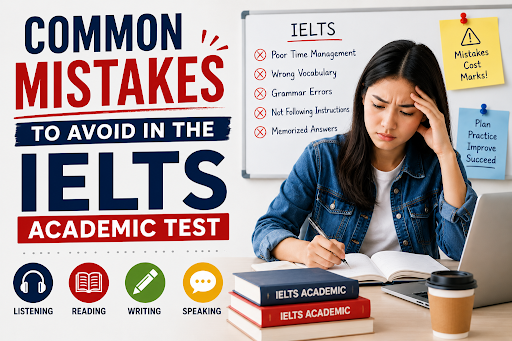
Common Mistakes to Avoid in the IELTS Academic Test
The IELTS Academic test evaluates your precise English communication under pressure. So if you want to achieve a high score, then you should be fluent in English in academic settings. IELTS Academic is a strictly timed and structured test that evaluates your linguistic skills.
Achieving a high score not only requires preparation but also requires avoiding some common mistakes. You should avoid the common mistakes that thousands of test takers make every year, which can impact their scores. Here we tell you the common mistakes to avoid in the IELTS Academic test.
Section-wise IELTS Common Mistakes to Avoid
Here are the section-wise common mistakes with practices to avoid in the IELTS Academic test
| Test Component | Common Mistake | How to avoid |
| Writing | Copy the prompt text word-for-word | Paraphrase the essays by using synonyms and alternate structures |
| Reading | Spending too much time on one hard question | Limit yourself to 1 minute per question; guess and move on to other |
| Listening | Leaving blank spaces in the answer sheet | Fill in every single blank, because there is no penalty for guessing |
| Speaking | Delivers memorized answers | Focus on organic pacing and natural communication |
7 Common Mistakes to Avoid in the IELTS Academic Exam
Some simple mistakes can lose your marks in IELTS Academic, so you have to be aware of them. You must avoid these common mistakes to improve your performance, boost confidence, and get a high score.
1. Not understanding the Test Format
Those who do not understand the test format of the IELTS Academic exam can fail to achieve the desired band. So you have to understand the format properly. This test has four sections, Listening, Reading, Writing, and Speaking. Each section has a specific pattern and timing structure.
So, become familiar with the test format to simulate a real exam and avoid confusion. Before starting preparation, you should learn the structure, number of questions, scoring criteria, and timing for each section.
2. Misunderstand Instructions
Misunderstanding instructions is another common mistake to avoid in the IELTS Academic test. Each section has its own instructions, so follow them properly. Ignoring it can cause unnecessary mistakes. To avoid this mistake, you must read the instructions carefully twice before answering. If you have any doubts, then you should clarify it with the examiner before starting.
3. Poor Time Management
IELTS is a time-strict test, so having time management skills is important. Each section has a strict time limit. For example, writing task 1 allot you 20 minutes, and writing task allot you 40 minutes. So complete each task within the given time. Don’t spend too much time on a single question.
If you have confusion in any question, then don’t stick to it; move ahead. Move on and return later if time allows. This approach ensures you don’t leave any questions unanswered.
4. Not Using Appropriate Vocabulary and Grammar
Using the wrong vocabulary and grammar is a common mistake in the Writing and Speaking sections of the IELTS Academic test. So avoid using complex words incorrectly, and ensure your grammar is correct. To improve your vocabulary and grammar, here are the tips you can follow
o Learn New Words: Expand your vocabulary by learning new words daily.
o Practice Grammar: Use grammar exercises to improve accuracy.
o Use Synonyms: Avoid repetition by using synonyms where appropriate.
5. Poor Pronunciation and Fluency
Poor pronunciation and lack of fluency also affect your score. It is a common mistake for non-native English speakers to avoid in the IELTS exam. Here are the tips to improve pronunciation and fluency
o Practice Speaking Daily: Engage in conversations in English every day.
o Record Yourself: Listen to your recordings to find and correct mistakes.
o Seek Feedback: Get feedback from native speakers or tutors.
6. Memorizing Answers in the Speaking Test
Some students memorize speaking answers found online or in coaching materials. Examiners can usually spot memorized responses easily because they sound unnatural and rehearsed.
The Speaking test in IELTS Academic assesses communication ability, fluency, and spontaneity. Candidates should express ideas naturally instead of reciting prepared scripts. Practicing speaking regularly on various topics can improve confidence and fluency.
7. Lack of Practice with Listening Accents
The Listening section of IELTS Academic features various English accents, including British, Australian, and Canadian. Many students practice only one accent and struggle to understand different pronunciations during the exam.
You should listen to the news, English podcasts, academic lecturers, interviews, and audiobooks regularly to improve your listening skills. Familiar with different accents improves comprehension and listening accuracy.
Conclusion
Avoiding these common mistakes in the IELTS Academic exam can improve your performance and chances of achieving a high score. Proper preparation, effective time management, understanding instructions, and practicing all four skills are essential steps in this process.
For those wishing to study in Australia and needing extra support, they can contact Alfa IELTS. It offers useful resources and expert guidance. Alfa IELTS can help you prepare effectively for the IELTS exam and achieve the scores you need for your academic goals. Explore Alfa IELTS services today and take the next step towards your future with confidence.
FAQs
Q1. What is a common mistake to avoid in IELTS Academic?
Ans: Poor time management, ignoring instructions, weak vocabulary, and grammar are the common mistakes to avoid in the IELTS Academic test.
Q2. How to increase the IELTS Academic writing score?
Ans: To improve your writing score, you should practice essays regularly, learn the task structure properly, improve vocabulary and grammar, and review feedback to identify your mistakes.
Q3. Why are the IELTS Academic mock tests important for preparation?
Ans: Preparation through mock tests is important to understand the exam pattern, identify weak sections, improve time management skills, experience real test conditions, and improve your confidence for appearing in the real test.
Q4. Can grammar mistakes reduce IELTS Academic score?
Ans: Yes, grammar mistakes can also impact your score, because the examiners evaluate your sentence structure, grammatical accuracy, and language clarity while calculating band score.
Q5. How often should I practice for the IELTS Academic test?
Ans: You should practice for it daily to improve your time management, grammar, vocabulary, fluency, and listening comprehension, and achieve your higher band score.
¡Suscríbete!